Showing posts with label Movies. Show all posts

Thursday, December 24, 2009

Avatar Impressions


Avatar
is not the shallow sludge of a movie that some negative reviews would lead you to believe. Nor is it the hyped "future of film" that, I'm convinced, nobody really fell for anyway. What it is is a mildly formulaic redemption story with more than its share of character, which uses its technology well and puts together some very coherent, enjoyable action that's as stylized as it is realistic.

What Avatar does well, most importantly, hasn't ever really been done before. This is the point, what people are saying when they call Cameron's latest epic the future of film. This movie's character comes primarily from its use of detail - the vast attention (and dinero) that went into the film is clearly apparent. For the first time, CGI creatures have quite literally the same personality and even charisma as human actors. I don't mean this lightly - in the massive scenes of congregated indigenous "aliens", you feel the same sense of organization and unity that you'd get from a crowd scene of dedicated extras, and the alien doppelgangers that the humans jack into Matrix-style mimic their facial expressions and demeanor with uncanny, blissful accuracy (the blue, CGI Sigourney Weaver in particular is incredible to watch).

It would be easy to dismiss Avatar as Pocahontas in space with a few technological gimmicks, but this would neglect the fact that all of the technology is being used in the service of the story. A somewhat predictable story in the hands of gifted cinematographers, animators who know what they're doing and some committed actors becomes as moving and involving an epic as any in recent memory. Even the actors playing sci-fi archetypes (the "bomb-'em-to-hell!" bulletheaded merc and the nerdy, ethical scientist) treat their roles with enough commitment that the movie is never shallow. This strong use of technology makes the film what it is, and the fact that none of this would have been possible even five years ago puts it firmly into the category of "modern" cinema. I fully understand why Roger Ebert cited the same feelings he felt watching the first Star Wars film in 1977 - this is an inventive, visually engrossing and, occasionally, moving film. The story is a couple of steps above mediocrity and the characterization more than a few.

The 3D effect, finally, is well-done, and never distracts from the story with flashy gimmicks (the kind that my oaf of a roommate insists upon). The main problems with cinema 3D, however, remain - a slightly blurry effect that makes focusing on quick motion or fine detail a little difficult - and your eyes may get tired for the first few minutes of the movie before you get used to using your muscles in that way.

In conclusion, I think that the film is well worth seeing, and since I'm not sure how well it will hold up on the small screen or second-run theater, I recommend seeing it now. It's nice to see a technological monstrosity employed for good rather than evil, and while the "plot" may be a little weak, the journey itself is handled very well, with action scenes that are not only fun to watch but actually matter.

[Note: Despite citing Ebert's review, I had not yet finished reading it when putting this together. Ebert makes his point regarding the film's action in a very similar way. The unintentional mirroring in my impressions review on that point is just that.]

Friday, December 18, 2009

Epic 70-minute video explains why The Phantom Menace was flawed


This guy does an excellent job of explaining the flaws in the Star Wars prequels. The highlight of Part One? "Describe the following Star Wars character without describing the way they look, or their profession in the films." Interesting characters abound in the original trilogy - Han Solo, for example. Now try it with Qui-Gon Jin or Amidala. Nope, "monotone" is not a character attribute.

Embedded above is part one. Follow this link for all seven parts. Oh, and yes, after part 2 in particular these videos get pretty hilarious. If you're not comfortable with serial killer jokes you may wish to move on, however.

EDIT: Language warning etc.

Thursday, December 10, 2009

Thoughts on Fantastic Mr. Fox


The film is charmingly ragged, both in design and writing, to the point that neither I nor my date could figure out if the consistently uneven picture focus was intentional or a projector error. The deadpan dialogue is subtle, humorous and breezy, with witty lines that don't spell out the jokes behind them. Scenes play out in unexpectedly creative ways due to the confident production, full of manic details and wonderful surrealism.

The movie almost seems symbolic, the specifics of the plot being mostly unimportant, at times like a sustained short film in its retro creativity. The aforementioned surreal elements add much to the film's effect (incendiary pinecones, wunderkind Kristofferson immediately grasping the rules of the incoherent game whackbat and the odd concentric eye circles gag). I've never seen a Wes Anderson before but this film makes a compelling case - it's subtle, full of thought and art, and comes straight out of left-field in intentionally awkward stop-motion glory. I really can't recommend this enough for anybody tired of cookie-cutter CGI romps and formulaic animated buddy films. It isn't Dahl's book in essence, but uses the book as a playground for something else entirely, something wonderful.

Tuesday, November 10, 2009

On Motives and Masking

After reading Orson Scott Card's treatise on Where the Wild Things Are, which basically branched into another critique of art cinema, I'm prompted to ask:

Can depth exist in a film beyond that which is spelled out and apparent? Are the only motives that a story is allowed to include the ones that are opened in front of you? Card's quibbles on the film are pretty clear:

[I]t's an art film -- which means that it is deliberately strange and unexplained. Things happen, but the writers and director go to some pains to conceal motive and reaction.

Oddly enough, the decision not to explain what's happening is usually regarded as a way to make a film "deep," but the opposite is the truth. When we are given no clue to the real motivations and intentions of characters, we have no choice but to settle for the most obvious -- the cultural cliches.

Orson Scott Card has made a highly successful, respectful career out of writing stories with very human characters who constantly explain (either through internal monologue or conversations with other characters) what they are feeling, exactly why everything is happening the way that it is and why they are doing what they are doing. And he's done this for the most part without sacrificing depth or meaning. But this is by no means the only way to create.

Movies don't have the benefit of pages of internal monologue, and real life has ambiguity. You can't always read somebody's emotions, and people often behave in odd, unpredictable ways that even they don't fully understand. Art cinema is clearly influenced by much of modern thought - that which recognizes and even relishes some ambiguity in daily life. It's also been the only modern "genre" to really incorporate ambience successfully, something that we've lost as a society in our slam-bang thrillers and blah dramas. In his musical and literary tastes Card definitely leans toward traditional forms - traditional singers and stories - over later, more postmodern stuff that learned to incorporate the dissonance and ambiguity we see in real life to great effect.

Is writing a film with deliberate structural engineering designed to underscore something really that bad? Surely there's room for films with subtle elements you can't grasp immediately, and the existence of such is not necessarily a blaring klaxon designed to alert us to pretension or hackery. Even as a lover of straightforward stories some of my favorite films have been exceedingly dry affairs with a lot of subtext, with things both intended and unintended to think about after the film ends and catch on subsequent viewings. (It took me ages to realize the irony of No Country For Old Men's Anton Chigurh getting into a sudden car accident, and it blew my mind. It was a deliberately contradictory element and I loved the implications.)

I've always defined "art" as that resonant feeling you get when you appreciate something but can't necessarily verbalize exactly why. I love that feeling, as I also love straightforward stories. I kind of wish that more people could learn to appreciate well-engineered experiences without impugning the motives of those who created them.

Sunday, August 16, 2009

Thoughts on movies from an erstwhile movie snob

Why do we have so few movie sequels that really continue a narrative? We're far more likely to see a new group of characters, maybe with a couple of return parts for novelty, go through the motions of the first movie in a series rather than continue the evolution of a character.

The best we can usually hope for is something like Harry Potter, where characters and their interrelationships are developed by being consistently thrust into similar situations over a long period, with enough variation and cinematography flashiness to keep from getting stale. Building up the mythos of a world is what passes for storytelling in a world of focus groups and demographics, and I'll usually stand for it.

But imagine if sequels really took their characters seriously as characters and not props for a plot, for example if Stallone's Rocky Balboa had been permitted to develop the way an individual might rather than getting roped into a series of increasingly unlikely fights for every sequel that rolled around. After all, the story was really about "Hey Adrian!" and the disconnect between being a nice guy and not really knowing what to do (or often being forced to do the wrong thing, for example muscling debtors for a loan shark). Why not pursue what fame adds to the mix rather than ending every flick with a setpiece fight? I mean, other than the fact that even the creators of the film feel that Rocky was a boxing movie.

What happens if James Bond gets fired, loses his access to awesome technology and has to work out a budget? Characters don't really grow unless you change the dynamic under which they're tested, and this doesn't happen if they keep meeting and besting the same challenges over and over.

I don't mean to say that movies don't do this. The Dark Knight took the invulnerable superhero mystique of the first film and destroyed it by making Batman essentially powerless, and, from what I've heard, Babe 2 subverted audiences and market expectations to deliver a truly thought-provoking story (bad move - the movie tanked). And, despite the gaudy horror of the cloying, unwatchable Toy Story 3 trailer, the crew seems genuinely dedicated to closing the "dramatic arc" of sorts of a toy who had been in denial of, and finally comes to grips with, his own mortality (though to be fair they'll probably just introduce a couple of new characters and have another adventure with a few calculatedly somber moments, which is pretty much what we're looking for anyway).

I'm not a snob, and I like most quality sequels even if they don't blaze much new territory (read: the stylish, fun, but mostly unmoving Hellboy II), though I'd like to see some major league sequels really shake up the dynamic of the story and not leave recontextualization to parody comedy shows and webcomics. The whole "reboot" thing (read: a sequel in practice but without the work of having to come up with a completely new plot) is getting old, and sequels that exist only to rehash the plot of the first movie (National Treasure 2: Blah of Blahcrets) are still safely ignorable, so we have plenty of time to turn Hollywood around before the novelty of CGI explosions even comes close to wearing out.

A final caveat: My apology if my points of reference seem to be mainly sci-fi, fantasy and superhero movies. Granted, they comprise the majority of what I watch, but not a controlling one.

Saturday, August 08, 2009

Roger Ebert Reviews "G.I. Joe"

Have fun at G.I. Joe, Middle America.


"G. I. Joe: The Rise of Cobra" is a 118-minute animated film with sequences involving the faces and other body parts of human beings. It is sure to be enjoyed by those whose movie appreciation is defined by the ability to discern that moving pictures and sound are being employed to depict violence. Nevertheless, it is better than 'Transformers: Revenge of the Fallen.' " - Roger Ebert

Link

Much of the context for this amazing quote can be taken from Paramount's marketing strategy for the movie:

G.I. Joe: The Rise of Cobra" opens Friday, but Paramount Pictures isn't screening the blockbuster for critics beforehand. . . Instead, the studio says it's intentionally aiming the movie at the heartland, at cities and audiences outside the entertainment vortexes of New York and Los Angeles. . . While appealing to a sense of patriotism nationwide, the plan also is inspired by the disparity that existed between the critical trashing "Transformers: Rise of the Fallen" received and the massive crowds it drew at the box office.

"`G.I. Joe' is a big, fun, summer event movie — one that we've seen audiences enjoy everywhere from Andrews Air Force Base in Maryland to Phoenix, Ariz.," said Rob Moore, vice chairman of Paramount Pictures. "After the chasm we experienced with `Transformers 2' between the response of audiences and critics, we chose to forgo opening-day print and broadcast reviews as a strategy to promote `G.I. Joe.' We want audiences to define this film."

Translation: Paramount knows you're shallow but they'd love a shot at your wallet.

This final quote from Ebert's review was too previous to pass up:

There is never any clear sense in the action of where anything is in relation to anything else. You get more of a binary action strategy. You see something, it fires. You see something else, it gets hit. Using the power of logic, you deduce that the first thing was aiming at the second thing.

Thursday, June 25, 2009

The BBC Reviews "Transformers: Revenge of the Fallen"


I wish I had thought of this. The page makes it clear that this is actually a review of all of Michael Bay's work, a sort of appropriate retrospective. Had I not edited the inch-long footer out of existence you would have seen that without my telling you.

Monday, June 15, 2009

Drag Me To Hell, Please (for about an hour and a half)


I've often thought that films should be able to get away with parenthetical afterthoughts much like our popular songs do. For example, "(I Can't Get No) Satisfaction" by The Rolling Stones. How about "(We're Going) Up?" Or "Land of the Lost (Plot)?" At any rate, if "Drag Me To Hell" were to follow this pattern it wouldn't need much more than a simple "(Don't)" before the title. Certainly the phrase doesn't appear anywhere in the movie, the event described not being particularly desirable.

So I'm forced to conclude that the title must refer to a desire by the film's audience for a little hellraising. And in this respect "Drag Me To Hell" does not disappoint. It's more or less pure horror in a schlocky, outrageous sort of way - the type you might see in an old "Tales From the Crypt" comic or a Stephen King short story. The film isn't a comedy in the sense that some other reviews may lead you to believe - the humor comes mainly from how audacious the film is, how thrillingly tasteless and outrageous it manages to be without treading into sadistic terroritory.

The film is appropriately tense, essentially one scare moment after another, each topping the last in grotesque, often groan-inducing fun. There isn't a moment in this movie that's meant to be taken seriously, which is probably a good thing - the film's peripheral characters are about as goofy and one-dimensional as the ones we've seen in Spider-Man. Unlike the Spider-Man flicks, however, this is actually an asset to the film, because the simple archetypes (the assertive jerk co-worker, harsh old-worlder Gypsy woman, or knowledgeable Indian fortuneteller) fit the B-movie "Drag Me To Hell" labors to be. Sure, elements of characterization are there: the main character's slide into madness and desperation, a spiritual medium's desire to prove herself against the demons that defeated her years before, and a proud old woman who becomes demonic, spiteful and vicious when shamed. But these character-driven moments are usually (successfully) played for comedy and camp, chills, or all three.

I say "chills," but this doesn't seem appropriate. Because most of the running gags (an old woman and later a corpse tearing out chunks of our heroine's hair, or various questionable substances of every variety going out of their way to drench her) are more likely to elicit squirm-inducing laughs than the type of unsettling psychological moments that linger after a movie's credits. Even the abrupt "twist" ending is meant to be seen from a mile away, making it funny rather than unsettling, much like the end of a "Seinfeld" episode. The audience I was with kept laughing to and through the credits.

My advice: If you're any fan of old-fashioned horror without any dismemberment but chock-full of stuff that's arguably worse, go see "(Don't) Drag Me To Hell" with some like-minded friends. This is one for the theater. Oh, and "Sam Raimi's Return To Horror" might be a good name for a rock band or album (there go the last vestiges of my Dave Barry fixation).


Clumpy gives this movie: Three turkeys and half a douchebag

Tuesday, June 09, 2009

Dear Pixar, From All The Girls With Band-Aids On Their Knees

As somebody who enjoyed Up, I highly recommend this open letter from Linda Holmes of NPR to Pixar asking for female protagonists in their fantastic films:

I have nothing against princesses. I have nothing against movies with princesses. But don't the Disney princesses pretty much have us covered? If we had to wait for your thirteenth movie for you to make one with a girl at the center, couldn't you have chosen something -- something -- for her to be that could compete with plucky robots and adventurous space toys?

Or more to the point, why couldn't your first female central character be as specifically drawn as the women and girls (and girl robots, etc.) you're already writing as secondary characters? Ratatouille has a chef! WALL-E has Eve! The Incredibles has superheroes!

And Up...oh, Up has Ellie, who I could have watched forever. Seen only in flashbacks to the main story, Ellie is warm and hilarious, ambitious and fearless, and then gone for most of the movie. She provides the engine for the story, in many ways, but it's an old man and a little boy who actually get to hit the gas.

I don't like to make movies political, especially kids' movies, if I can help it. Sometimes a princess is just a princess and should be taken as such.

At the same time, little Russell, in Up, is Asian-American, right? And that's not a big plot point; presumably, he just is because there's no particular reason he shouldn't be. You don't need him to be, but you don't need him not to be, either. It's not politics; it's just seeing the whole big world.

Well, the whole big world has a lot of little girls in it, too. And not all of them are princesses -- and the ones who are princesses have plenty of movies to watch.

The Full Letter

Wednesday, June 03, 2009

"Up" and "3D" - Two things that go well together


Just got out of Pixar's Up, a film of balloons, poignancy and surreal adventure. Disliking this film seems impossible, and I found myself earnestly interested if not necessarily enthralled throughout the film's 96-minute running time. Like some of my favorite films, Up is pure storytelling, unafraid to indulge in a little magical ambience or intersperse subtle, touching moments with some seriously weird sight gags and nutty action.

It's best to go into this film blind to everything but the basic premise, which I'd bet you're already familiar with: A slightly cranky, slightly senile but mostly independent and warmhearted septuagenarian flies his house away to Venezuela with a bunch of balloons. Hijinks ensue. This is both a straightforward adventure story and a somber coming-of-(old) age tale, a dynamic I quite enjoyed. The action and humor onscreen is uniformly compelling, to be sure, but the reason for the trip is more important and earns exactly its share of screen time. And the film's finale - a plethora of goofy slapstick, characters dangling from precarious heights (uh, spoiler) and good old-fashioned adventure - is something to behold. Really, you can literally behold it. It's right there in front of you.

Mainly due to the various rocks I've been hiding under, this whole 3D element took me somewhat by surprise. We finally opted to spring for a 3D showing, something I highly recommend. You get a pair of goofy glasses and there's no eyestrain, so why not? Due to the technology involved the screen's a little darker, but the film's 3D is such a subtle effect and adds to the scale of the film to such a degree that I would urge the moviegoing public to take that route. My roommate insists that 3D is wasted on anything but a film full of snakes jumping at the camera and similar gimmickry, but he can cram it. Go see Up!

Further Reading:

I review Star Trek The Dark Knight Hellboy II Wall-E Alvin and the Chipmunks Iron Man

Wednesday, May 20, 2009

Clumpy Sort of Reviews: "Star Trek"


The new Star Trek film should have been pretty terrible. Certainly the film's trailer didn't win me over a few months ago by featuring a rebellious preteen Kirk driving a car over a cliff and getting arrested by some kind of floating stormtrooper space cop. I heckled the trailer with my roommates and prepared for a noisy, incoherent film with little respect for the source material (particularly that aspect of the source material most important to me - the characterization and entertaining interplay between the franchise's leads).

But Star Trek does not suck. In fact, it's the best, and certainly one of the most compelling new films that I've seen all year. (It's also the first new film that I've seen this year, but who's counting?) Director J. J. Abrams' last film, Cloverfield, was a visually snazzy, jittery flick with little resonance, but Star Trek's appeal lingers long after you leave the theater. I won't say that the movie is necessarily thought-provoking, per se (not that the others were), but it achieves the impossible: Star Trek remains true to the spirit of the original films while updating the style and narrative for new audiences.

One of the things that I found most impressive about the film is the way that it takes elements of Star Trek that we're more than tired of and makes them appealing again. For example, remember the hundredth time that you heard somebody say that shields were at 35%, sparks shot around the cabin and an officer went flying across the bridge? Get ready for that to be exciting again. The whole film swaggers forward with so much sleek celluloid energy and drive that you won't even be reaching for the light button on your watch or making sarcastic comments about the cinematography (there'd be nothing to say - it's uniformly compelling).

And man, is the casting good. Say what you will about the charisma of the original Star Trek cast (speaking more particularly of the later few of the original films), but they nearly always looked like exactly what they were: aging, campy character actors filling well-known roles. In contrast, the new actors take the best quirks and mannerisms of the original cast and ground them into more realistic roles. Who would have thought that Simon Pegg would be the spiritual successor to James Doohan/Scotty, or that Karl Urban could take the cranky cynicism that DeForest Kelley brought to Dr. McCoy and make him seem like an actual doctor? Uhura's great, Spock is turmoiled and flawed (and the symbolic passing of the torch provided by Leonard Nimoy frankly gives the film a huge share of its dignity) and the film's villain is actually played as something other than a cold, calculating alien captain for once. He's a good villain - powerful and deadly, yet emotionally unstable and prone to rash decisions.

Only Anton Yelchin's portrayal of Pavel Chekhov is close enough to approach parody, but I found the near-direct tribute to Walter Koenig charming (my roommate, who doesn't like IV and VI as much as I do, wanted to kill him for his accent). John Cho's portrayal of Sulu is quite different from George Takei's (and honestly not much varied from some of his previous roles), but strong in different ways. Not a single major character is neglected in the screenplay, yet everything's so organic that the action rarely feels forced. Even the sequence I mentioned earlier - the car-stealing young Kirk one - makes sense in the updated storyline.

Everything's there - the humor, the emotional hooks, the relationships between the characters and some of the best sci-fi action in recent memory. If the film has any weaknesses, it's that having to bring together so many characters so quickly leads to some ridiculous coincidences, at times even making the flick feel like a road trip movie ("Oh, hi, Scotty! Spock, what are you doing in that cave? Climb aboard, both of you!"). Oh, and one sequence with computer-generated monsters is completely clichéd and unnecessary. Notwithstanding those minor gripes (which really don't impact the film much at all), complaining about Star Trek would require a level of nitpickery I'm not sure that I'm capable of. The film makes no pretensions to be anything other than a solid, straightforward adventure flick, and unlike most films in this genre, it actually gets it right.

Not sure that I understood the ending, though.

EDIT (5/22): A few additional insights I've gained after stewing things over for a few days (spoilers will be pretty bad here):

- I really can't overstate how good Karl Urban in particular is as McCoy. The performances in this film are so organic in part because no single character steals the limelight in this film. Even the most minor of characters - Captain Pike, for example - are well-casted and have a great deal of moral authority. And somehow making this film without Leonard Nimoy on hand would have left it feeling slightly empty for me - he is Spock, after all, in my mind - so his inclusion in the movie is pretty special.

- The spaceships are really fun to watch. There's a primal appeal to the surreal feel of watching Nero's Romulan/Borg mash-up ship loom into view or the gleaming bridge of the Enterprise. Klingon ships really only show up during the Kobayashi Maru simulation bit - I'd be interested in seeing what they do with the Klingons in the next film (coming in 2011!).

- The alternate timeline allows them to have a lot of fun with the universe and take chances without succumbing to "prequel" syndrome. In a sense they're able to revisit old characters and settings, but with the understanding that things might not necessarily occur in the same way. I can't help but hope that the ballsy destruction of Vulcan [!!!] isn't the first major change to come. I have faith that this production team can pull off Khan again, for example, in some capacity, and that we can skip the fairly boring terraforming/Marcus family subplots that dragged down some of the earlier Trek flicks in my opinion. Every variation teased in the story (like Pike's alternate but similar fate or the Uhura/Spock dynamic) holds extra interest for people like me with a cursory understanding of the movies.

Much like last year's The Dark Knight, this movie's aura sticks with you for quite a while thereafter and leaves you feeling giddy and excited about the source material again. There's a lot of stuff to think about - masterfully-executed characters, situations and scenes that give the movie far more value than something that merely distracts you for a couple of hours. I can't imagine this movie failing to hold up under multiple showings or failing to please anybody other than orthodox Trekkies/Trekkers who've already made up their mind.

Related posts:
7-11 clerk attacked at bet'lethpoint (with smart-aleck analysis)
See Spock Run (My Webcomic)

Saturday, May 09, 2009

Koyaanisqatsi

The classic Geoffrey Reggio/Philip Glass fast-motion slow-motion city flick Koyaanisqatsi is available online, courtesy of MGM! Yes, it's the movie you learned about in film school! Yes, it's basically a trippy montage critiquing modern human society and its effect on the environment! But it's Koyaanisqatsi and it's trippy in the right ways, and each montage brings something new. Watch it!

Watch Koyaanisqatsi

Sunday, March 29, 2009

Technically the whole title is a single noun


The new trailer for "Where the Wild Things Are" (watch one of the HD ones if you can) is one of those rare trailers that crackles on your monitor. It looks like a triumph of visual effects and emotion, and it's directed by Spike Jonze to boot. Glad to see they seem to be retaining the spooky, heartfelt raggedness of the original picture book. Remember that only about a year ago we thought they were considering reshooting the whole thing for mass appeal, so this is no small deal.

Friday, January 16, 2009

"Khaaaaaaaaaan!"


Well, I think this image speaks for itself. This immediately stuck out to me because I did the exact same experiment about six months ago and neglected to post about it. Too bad - I could have jumped the gun on these guys.

How Many AAAAs in Khaaaaaaaan?
(flickr user Negatendo via BoingBoing)

Related links:

See Spock Run (Children's Primer Idea)
The First Two Pages of the Book

Thursday, December 04, 2008

Folk Songs Turned Into Awesome Movie Trailers (Rewrite)

This is a rewrite of a proposed movie trailer I did about a year ago. You should really hear me say it aloud for the full effect, but it's still worth reading:

---
Onscreen: "The following PREVIEW has been approved for ALL AUDIENCES by the Motion Picture Association of America."


A group of FORENSIC DETECTIVES is sitting in a large board room, going over unseen grisly photographs. The camera pans over the room, to the grim face of DR. WOLVERTON, the program head (Morgan Freeman if we can get him).

DR
WOLVERTON: "Team, we are tracking a dangerous killer. Every time he takes a life, he adopts the surname of his victim. First his name was "John Jacob". Then he killed Doctor Alfsheim Jingleheimer. "

[A BEAT AND CAMERA ANGLE CHANGE]

DR.
WOLVERTON: "Dr. Schmidt, I'm putting you in charge of this investigation. We need to stop our friend before his name has a chance to grow any longer."

INSPECTOR SCHMIDT nods grimly.

---

NIGHT - INSPECTOR SCHMIDT is working at his drawing room computer, beads of sweat dotting his brow as he feverishly searches through documents, images, databases. A beat. The music rises as sudden comprehension dawns on his face. The music and breath sound effects rise to a crescendo, and, as the camera draws nearer and nearer to the man's face, come to an abrupt halt:

INSPECTOR SCHMIDT (WHISPER): ". . . his name is my name too."

A window breaks downstairs. SCHMIDT looks up quickly. What follows is a random sequence of inexplicable violent images, the type usually seen in movie trailers: A figure swings a sledgehammer at somebody who ducks as the wall is torn apart behind him. Someone jumps off of a roof. A fire hydrant explodes. DR.
WOLVERTON looks up from his desk and yells "Who's there!?", nervously picking up a pistol. A prison door creaks open, and an inmate within shields his eyes from the light and yells "WHAT DO YOU WANT FROM ME!?!"

---

Finally, everything fades to black. Spooky children's voices sing quietly to screeching sound effects:

CHILDREN: ". . . whenever he goes out, the people always shout. . ."

YOUNG GIRL (whispering): ". . . there goes John Jacob Jingleheimer Schmidt. . . ."

Through each beat of the pre-chorus ("LA LA LA LA LA LA LA LA!!!" ) a letter drops into place until the screen reads "July 2009" in blood-red letters.

---

I have some friends in the university film program who claim that they would like to help me make this trailer. I haven't yet taken them up on their offer (mainly because I'm sure they were sincere when they offered to help but won't actually be so enthusiastic when the time comes, but also because I'm sure I can't match the awesome image in my head and I'd rather leave it the way it is. We'll see, I guess.

Friday, October 03, 2008

Cinematic Polemic

(DISCLAIMER: I'm going to be discussing two films in this post, neither of which I've seen. If you feel that I've judged either of these flicks incorrectly, I urge you to read this as yet another unasked-for criticism of our culture. Danke schein.)

A couple of highly-charged bits of filmmaking are being thrown into wide release today: Religulous, a Bill Maher/Larry Charles screed on religion, and An American Carol, a shallow assault on progressive "anti-Americanism" that takes aim at traditional right-wing boogeymen (Michael Moore, Islamic fundamentalists, liberal college professors) and evokes ready comparisons to Uwe Boll's Postal.

Both these films seem to make their points earnestly while trying for a few jokes, and both do a hearty job of indicating the problems at work in America - and not in the way they expect.

Religulous, starring Bill Maher and directed by Seinfeld pioneer Larry Charles, is probably the funnier of the two, and fairly transparent. Anybody who knows anything about it already knows nearly everything about it - it's a documentary about religion (more specifically Christianity), and Bill Maher and Larry David are involved. I would expect the "cynical smirk to fair questions ratio" to hover around 5:1 for this one.

And it seems for all the world to be a typical attack documentary; Maher trots the globe, picking the sorriest, most pathetic religious believers and pointing out that they are, in fact, silly goons. It's the film equivalent of Jay Leno asking people on street corners how many sides you'd find on a triangle ("Four! No, wait - is it an odd number?"). When you consider that a good 88% of human beings identify themselves as believers in God, it's no significant surprise that an earnest agnostic-faced atheist managed to find a few stupid jackasses among them to ridicule. I even know a few myself! It's been awhile since the fact that some people believe in God for wrong or even ignorant reasons made headlines, so kudos to Lions Gate for bringing it back to our attention. It's Borat for the Scientific American set! I'm sure the film is profoundly unfair, but if you already love/hate Bill Maher the way most of us do you'll know what to expect.

---

And if there's ever been a film designed by its very premise to repel me, it's David Zucker's An American Carol, wherein a left-wing nutjob (Michael Moore, played by a guy who looks a bit like Michael Moore) is visited by a bunch of right-wing nutjobs (y'know - Kelsey Grammar, Leslie Nielsen and Jon Voight, playing a bunch of ex-presidents who have posthumously converted to neoconservatism), who teach him that America is, y'know, really great and he should just shut his mouth. I never liked Zucker's films (Airplane and assorted spoofs that are essentially live-action versions of Mad Magazine fare), but this might be the first one that's actually dangerous.

I don't have a problem necessarily with reminding us of great, if clichéd, moments in America's past (the Revolutionary War, a general commitment to freedom and rule of law), but of the film's self-righteous militaristic patriotism, a philosophy adopted only recently by the neocon right wing who has done more to destabilize our freedom and civil rights - all while pointing toward brown people as the real enemies - than any flag-burner could ever desire or manage. Doesn't this film miss the point that criticism of a country's flaws, when appropriate, is one of the surest indicators that you love said country and want to improve it, and nationalistic, reactionist regressivism is one of the surest indicators of a slide toward self-righteous depravity and self-assured exceptionalism (one of the few things that could really destroy this country)? For those of you who managed to parse that gramatically-questionable sentence, it was a rhetorical question.

---

Does anybody else worry that the real conservative movement is over, and all we have left is the kind of Reaganesque neoconservative garbage and progressive hogwash that produces films like these? Why can't we get a real conservative picture to theaters, one that champions freedom and small government without legitimizing stingy treatment toward the poor, attacks the spiraling American Military Industrial Complex while understanding the need for a basic national defense, or champions the rights to free expression and privacy from government surveillance and interference without politicizing such an important, basic assault on our liberties? I'd like to see a picture that understands the Constitution and the Bill of Rights pragmatically, as necessary tools for freedom that we follow to the letter simply because they're the only anchors protecting us from misguided or even scheming politicians, without holding up the Constitution as an end in itself.

In other words, why can't we get a picture with some principles worth defending (defined, you'll notice, as those principles which happen to be mine)?

Monday, September 01, 2008

Hellboy and Pancakes


I've had this awesome story kicking around in my head for some time after reading it a few weeks ago. I came across it during my usual Google frenzy for a movie that I had been looking forward to (in this case, Hellboy II: The Golden Army). It's a couple pages of the comic, the infamous "Pancakes" story, and it's indicative of the wonderful element of humor found throughout Mignola's work. Enjoy!

The Pancakes Story (Hellboy)

Thursday, August 07, 2008

THX's Deep Note


Everybody who isn't a cabin-dwelling techno-bomber is familiar with the usually-unnamed crescendo of noise that appears before THX-certified films. Of course, this means that most films begin with this eargasm of a sound, the perplexingly-titled "Deep Note."

"Deep Note" doesn't really get as loud as it seems - apparently it has something to do with the number of voices involved in the clip, its dissonance as well as the continuously-rising volume which sweetens at the end.

Good luck, though, trying to find a high-quality clip of the twenty second some-odd sound - THX is pretty anal about their copyright and tends to throw their legal muscle around in removing it; Dr. Dre was even sued in 2000 for sampling it, as if THX has anything to lose from the further dissemination of an already-infamous sound. Some YouTube facsimiles exist, but YouTube keeps their audio bitrate low for legal reasons so, as always, you'll be more successful with the parodies and the tributes (including this neat a cappella rendition).

Sigh. . . I'll keep looking, under the hopes that I can find a high-quality mp3 of the file and really give my speakers a test. . .

Sunday, August 03, 2008

Harry Potter and the Half-Blood Prince Trailer Online!

For those of you contemplating a trip to see a recently-released Brendan Fraser flick just to watch this trailer, don't bother - it's already online. Heck, I don't break stories - it's been up for three days. I always tell myself that I won't get excited for these things and then I always do. I suggest that you watch it from this link (or even from one of the fancy HD links), but the less waiting-inclined can always YouTube it right from my li'l blog:


Watch it a few times to make up for the fact that you're not seeing it on the big screen before "The Mummy". Better yet, watch this a few times and then go see The Dark Knight or Hellboy II again.

EDIT: I've really gotta fix these date markers - my Blogger account thinks that I'm nocturnal.

Saturday, July 19, 2008

Holy Psychodrama, Batman! (The Dark Knight Review)

At the end of 2005's Batman Begins, Gary Oldman's character Commissioner Gordon gives a strange little speech that never quite made sense lo those many years ago: As Batman expresses optimism that Gotham will return to normal following the events of that film, Gordon responds: "Will it? What about escalation? We start carrying semiautomatics, they buy automatics. We start wearing kevlar, they buy armor-piercing rounds."

"And," Gordon continues, "You're wearing a mask and jumping off rooftops".

Though the rest of Gordon's dialogue sets the stage more explicitly for a sequel, it's clear after watching the recently-released The Dark Knight that Gordon's speech was oddly prescient, as a single theme permeates the entirety of this film: escalation. If nothing else, The Dark Knight represents an escalation of nearly every aspect of the Batman saga. An escalation in stakes, certainly, but also an escalation in tension and good-old-fashioned fear. But first, a word: I can't imagine that I'll be including specific spoilers of any kind in this review, but you'll certainly hear about little scenes and vignettes from the film, and (hopefully) get a pretty general idea of how the movie works. Bottom line: I won't ruin the movie for you, but if you're wishing to retain your Dark Knight virginity you'd best stop here.

All right - stumbling out of the theater at 2:30 this morning, I struggled to gather my thoughts regarding what I had just seen. Usually when I exit a film, I have a pretty good idea of how I felt about it, but The Dark Knight left me so overwhelmed that I had trouble getting my brain back to square one. Most dramas and thrillers feature pretty clear ebbs and flows of action and emotion - tense scenes followed by comic relief followed by a few pacing scenes (followed, of course, by more tenseness). Knight shatters this pattern by including everything conceivably possible nearly all of the time. Comic relief? You've got it, but not before or after the traditional nailbiting intensity - right in the middle of it. Picture the coin flip scene from No County For Old Men on nitrous oxide and you'll have a pretty good idea of what to expect.

From the first shot to the credits reel, The Dark Knight is an unrelenting cavalcade of plot twists, violence, dark humor, brilliant performances and deft little touches. You'd hardly believe that you're watching the successor to Batman Begins - director Christopher Nolan has taken the essence of the first film, caffeinated it and set it loose upon an unsuspecting audience. While Batman Begins was a fantastic, believable superhero origin story with quiet spots and mystic elements, The Dark Knight is a 150-minute gritty crime drama, injected with funny brutality but no schadenfreude, filled with intense, creative action but no escapism. Prerelease hype aside, it's more De Niro than Daredevil, more Scorsese than Superman.

The Joker, pictured during one of the film's
many gritty, rousing dance numbers.

Most of this is on account of The Dark Knight's perplexing new villain: The Joker, played with manic, unhinged brilliance by Heath Ledger, a now-deceased great modern actor named after a candy bar. Heath's joker is far more dogmatic than previous Jokers we've seen - most of whom were more humorous, rational and human than the one you'll see in The Dark Knight. No, this Joker is after means-to-an end destruction. This self-proclaimed "agent of chaos" sets out to send a message to modern society: order and structure are a sham. This is his creed and it leaves little room for hesitation, rest or empathy.

And the Joker is set out to destroy any order, from the well-maintained loyalty system of the mob(s) to Gotham City's police system, right down to the new district attorney Harvey Dent, the new symbol of a cleaner Gotham. The fact that The Joker accomplishes so much chaos in two-and-a-half hours is as much a testament to the destructive nature of chaos as it is to the escalative nature of sequels (there's that word again). In the last film, the League of Shadows planned for decades and got thwarted at the starting gate, but here the Joker arrives in town with nothing but a couple of knives and a healthy supply of carefree sadism and manages to bring the whole city to its knees.

The Joker's big on murder, especially when it serves a purpose. He's perfectly willing to throw people into elaborate Saw-style decision-driven death traps, or just to shoot at oncoming cars for the sheer unadulterated glee of it. The Joker's plans for the city spread about five levels deep, then just one more in case everybody was getting a little too complacent. While the first film pushed itself forward to a logical conclusion, Knight makes a point of being unpredictable and liquifying things to a bloody pulp just when you thought the characters had achieved some minor victory. And the normal thematic devices aren't used in the way you'd expect: the Joker serves as much of the film's comic relief, while also serving as the reason why comic relief is needed in the first place. It's an odd feeling, watching the scariest, funniest villain that you've ever seen.

But, as said above, the Joker is more of a force than anything - his giddy worship of chaos and dissonance has no concrete end. "A plan?!" he bellows incredulously at one point (and here I'm writing from memory), "You think I have a plan!? I just do things. I'm not a schemer. I'm a dog chasing a car - I don't know what I'd do if I ever caught one." He shudders and shakes his head in horror - another brilliant Joker moment in a film full of brilliant Joker moments.

So while Batman Begins was very much Bruce Wayne's movie, it seems that The Dark Knight has been given to the Joker, and the entire film has inherited its attention to detail and affinity for anarchy from the purple-suited psycho. The Dark Knight is so supersatured with events that its two-and-a-half hour running time seems barely enough to contain it. In keeping with the spirit of the film everything else has changed, too: Batman's Gotham is seen far more often during the day, for example, yet appears somehow more drab and lifeless than ever. The movie is filled with action, but it's tense and paranoid. It's all thrilling, yes, but there are no "Whoo-hoo!" moments to sate the escapist expectations of audiences. This movie is more about character and rules than a fight between good and evil - The Joker has no rules, certainly, and his fight becomes a quest to get Batman to break the one rule he lives by. Break it he doesn't, but he gets close.
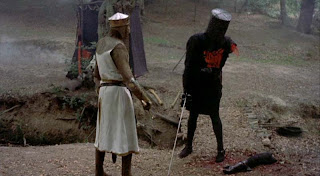
The Dark Knight takes a wounding blow in
one of the film's many thrilling battles.

The film doesn't seem to resolve itself until you think about its final idea - that by not being a hero, Batman could turn out to be the greatest protector the city could ever hope for. I won't spoil anything, but the circumstances surrounding this theme are the only things that bring this film to anything approaching a satisfying emotional conclusion. It's something that Bruce Wayne had been considering the whole film, then was finally forced to achieve in a completely different way than he'd ever expected. It's the bittersweet Empire Strikes Back-style pseudo-resolution that leaves you wanting the third installment but changes things enough to give you something to look forward to.

This movie is as quotable, thought-provoking and well-shot as anything that you're likely to see this year, though a first viewing of the film may leave you feeling confused and unfulfilled, albeit exhilirated. A conversation earlier at the Wendy's with a stranger who had seen the movie earlier in the day (a nice guy from Ghana - he's not from around here or he would have been sulky and distrustful like everybody else) has brought me a bit closer to understanding my feelings regarding the entertainment value of the flick:

"I'm still not sure how I feel", he said. "I think I liked it, and I'm glad that I saw it, but I'm still not sure if I'll want to see it again."

So this film is a few things that Batman Begins wasn't - for one thing, it's a vehicle for bringing Tarantino levels of sadism and violence to a PG-13 audience [Thanks for the $$$, Warner Brothers! - MPAA]. It's an ambiguous exploration of personal borders, the vices and virtues of humanity. It makes you think, and forces you to find enjoyment in ways other than the typical superhero movie, even considering some of the outstanding releases this generation has seen. It's a movie that challenges its audience, rather than just delivering the expected standout fight scenes and nifty one-liners. It's pretty much everything that it needed to be, but not necessarily everything that you might have wanted it to be, and I think that I liked it, and I'm glad that I saw it, but. . . well, you see where I'm going here.

By the film's end, you'll be so drawn into the movie's hellish psychological nightmare that the sight of a fancy new Bat-gadget or Bat-backflip won't grip you, but the vicious internal turmoils and psychological mindgames might. Don't go in expecting Iron Man, or even something close. And if I haven't made it clear already. . . don't bring the kids to this one.

(NOTE: Academy Awards people - please give joint Oscars to Michael Caine, Morgan Freeman, Gary Oldman and Heath Ledger for their fantastic performances. I understand that you are all regular readers of this blog and thank you.)