
7 hours ago
Showing posts with label Reviews. Show all posts
Showing posts with label Reviews. Show all posts
Thursday, June 25, 2009
The BBC Reviews "Transformers: Revenge of the Fallen"
I wish I had thought of this. The page makes it clear that this is actually a review of all of Michael Bay's work, a sort of appropriate retrospective. Had I not edited the inch-long footer out of existence you would have seen that without my telling you.
Monday, June 15, 2009
Drag Me To Hell, Please (for about an hour and a half)

I've often thought that films should be able to get away with parenthetical afterthoughts much like our popular songs do. For example, "(I Can't Get No) Satisfaction" by The Rolling Stones. How about "(We're Going) Up?" Or "Land of the Lost (Plot)?" At any rate, if "Drag Me To Hell" were to follow this pattern it wouldn't need much more than a simple "(Don't)" before the title. Certainly the phrase doesn't appear anywhere in the movie, the event described not being particularly desirable.
So I'm forced to conclude that the title must refer to a desire by the film's audience for a little hellraising. And in this respect "Drag Me To Hell" does not disappoint. It's more or less pure horror in a schlocky, outrageous sort of way - the type you might see in an old "Tales From the Crypt" comic or a Stephen King short story. The film isn't a comedy in the sense that some other reviews may lead you to believe - the humor comes mainly from how audacious the film is, how thrillingly tasteless and outrageous it manages to be without treading into sadistic terroritory.
The film is appropriately tense, essentially one scare moment after another, each topping the last in grotesque, often groan-inducing fun. There isn't a moment in this movie that's meant to be taken seriously, which is probably a good thing - the film's peripheral characters are about as goofy and one-dimensional as the ones we've seen in Spider-Man. Unlike the Spider-Man flicks, however, this is actually an asset to the film, because the simple archetypes (the assertive jerk co-worker, harsh old-worlder Gypsy woman, or knowledgeable Indian fortuneteller) fit the B-movie "Drag Me To Hell" labors to be. Sure, elements of characterization are there: the main character's slide into madness and desperation, a spiritual medium's desire to prove herself against the demons that defeated her years before, and a proud old woman who becomes demonic, spiteful and vicious when shamed. But these character-driven moments are usually (successfully) played for comedy and camp, chills, or all three.
I say "chills," but this doesn't seem appropriate. Because most of the running gags (an old woman and later a corpse tearing out chunks of our heroine's hair, or various questionable substances of every variety going out of their way to drench her) are more likely to elicit squirm-inducing laughs than the type of unsettling psychological moments that linger after a movie's credits. Even the abrupt "twist" ending is meant to be seen from a mile away, making it funny rather than unsettling, much like the end of a "Seinfeld" episode. The audience I was with kept laughing to and through the credits.
My advice: If you're any fan of old-fashioned horror without any dismemberment but chock-full of stuff that's arguably worse, go see "(Don't) Drag Me To Hell" with some like-minded friends. This is one for the theater. Oh, and "Sam Raimi's Return To Horror" might be a good name for a rock band or album (there go the last vestiges of my Dave Barry fixation).
 Clumpy gives this movie: Three turkeys and half a douchebag
Wednesday, June 03, 2009
"Up" and "3D" - Two things that go well together

Just got out of Pixar's Up, a film of balloons, poignancy and surreal adventure. Disliking this film seems impossible, and I found myself earnestly interested if not necessarily enthralled throughout the film's 96-minute running time. Like some of my favorite films, Up is pure storytelling, unafraid to indulge in a little magical ambience or intersperse subtle, touching moments with some seriously weird sight gags and nutty action.
It's best to go into this film blind to everything but the basic premise, which I'd bet you're already familiar with: A slightly cranky, slightly senile but mostly independent and warmhearted septuagenarian flies his house away to Venezuela with a bunch of balloons. Hijinks ensue. This is both a straightforward adventure story and a somber coming-of-(old) age tale, a dynamic I quite enjoyed. The action and humor onscreen is uniformly compelling, to be sure, but the reason for the trip is more important and earns exactly its share of screen time. And the film's finale - a plethora of goofy slapstick, characters dangling from precarious heights (uh, spoiler) and good old-fashioned adventure - is something to behold. Really, you can literally behold it. It's right there in front of you.
Mainly due to the various rocks I've been hiding under, this whole 3D element took me somewhat by surprise. We finally opted to spring for a 3D showing, something I highly recommend. You get a pair of goofy glasses and there's no eyestrain, so why not? Due to the technology involved the screen's a little darker, but the film's 3D is such a subtle effect and adds to the scale of the film to such a degree that I would urge the moviegoing public to take that route. My roommate insists that 3D is wasted on anything but a film full of snakes jumping at the camera and similar gimmickry, but he can cram it. Go see Up!
Further Reading:
I review Star Trek The Dark Knight Hellboy II Wall-E Alvin and the Chipmunks Iron Man
Wednesday, May 20, 2009
Clumpy Sort of Reviews: "Star Trek"

The new Star Trek film should have been pretty terrible. Certainly the film's trailer didn't win me over a few months ago by featuring a rebellious preteen Kirk driving a car over a cliff and getting arrested by some kind of floating stormtrooper space cop. I heckled the trailer with my roommates and prepared for a noisy, incoherent film with little respect for the source material (particularly that aspect of the source material most important to me - the characterization and entertaining interplay between the franchise's leads).
But Star Trek does not suck. In fact, it's the best, and certainly one of the most compelling new films that I've seen all year. (It's also the first new film that I've seen this year, but who's counting?) Director J. J. Abrams' last film, Cloverfield, was a visually snazzy, jittery flick with little resonance, but Star Trek's appeal lingers long after you leave the theater. I won't say that the movie is necessarily thought-provoking, per se (not that the others were), but it achieves the impossible: Star Trek remains true to the spirit of the original films while updating the style and narrative for new audiences.
One of the things that I found most impressive about the film is the way that it takes elements of Star Trek that we're more than tired of and makes them appealing again. For example, remember the hundredth time that you heard somebody say that shields were at 35%, sparks shot around the cabin and an officer went flying across the bridge? Get ready for that to be exciting again. The whole film swaggers forward with so much sleek celluloid energy and drive that you won't even be reaching for the light button on your watch or making sarcastic comments about the cinematography (there'd be nothing to say - it's uniformly compelling).
And man, is the casting good. Say what you will about the charisma of the original Star Trek cast (speaking more particularly of the later few of the original films), but they nearly always looked like exactly what they were: aging, campy character actors filling well-known roles. In contrast, the new actors take the best quirks and mannerisms of the original cast and ground them into more realistic roles. Who would have thought that Simon Pegg would be the spiritual successor to James Doohan/Scotty, or that Karl Urban could take the cranky cynicism that DeForest Kelley brought to Dr. McCoy and make him seem like an actual doctor? Uhura's great, Spock is turmoiled and flawed (and the symbolic passing of the torch provided by Leonard Nimoy frankly gives the film a huge share of its dignity) and the film's villain is actually played as something other than a cold, calculating alien captain for once. He's a good villain - powerful and deadly, yet emotionally unstable and prone to rash decisions.
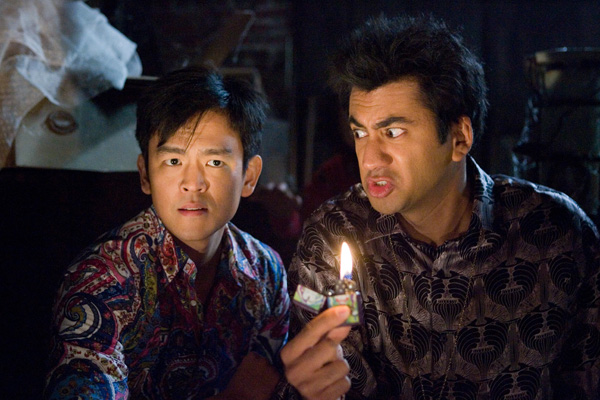
Only Anton Yelchin's portrayal of Pavel Chekhov is close enough to approach parody, but I found the near-direct tribute to Walter Koenig charming (my roommate, who doesn't like IV and VI as much as I do, wanted to kill him for his accent). John Cho's portrayal of Sulu is quite different from George Takei's (and honestly not much varied from some of his previous roles), but strong in different ways. Not a single major character is neglected in the screenplay, yet everything's so organic that the action rarely feels forced. Even the sequence I mentioned earlier - the car-stealing young Kirk one - makes sense in the updated storyline.
Everything's there - the humor, the emotional hooks, the relationships between the characters and some of the best sci-fi action in recent memory. If the film has any weaknesses, it's that having to bring together so many characters so quickly leads to some ridiculous coincidences, at times even making the flick feel like a road trip movie ("Oh, hi, Scotty! Spock, what are you doing in that cave? Climb aboard, both of you!"). Oh, and one sequence with computer-generated monsters is completely clichéd and unnecessary. Notwithstanding those minor gripes (which really don't impact the film much at all), complaining about Star Trek would require a level of nitpickery I'm not sure that I'm capable of. The film makes no pretensions to be anything other than a solid, straightforward adventure flick, and unlike most films in this genre, it actually gets it right.
 Not sure that I understood the ending, though.
EDIT (5/22): A few additional insights I've gained after stewing things over for a few days (spoilers will be pretty bad here):
- I really can't overstate how good Karl Urban in particular is as McCoy. The performances in this film are so organic in part because no single character steals the limelight in this film. Even the most minor of characters - Captain Pike, for example - are well-casted and have a great deal of moral authority. And somehow making this film without Leonard Nimoy on hand would have left it feeling slightly empty for me - he is Spock, after all, in my mind - so his inclusion in the movie is pretty special.
- The spaceships are really fun to watch. There's a primal appeal to the surreal feel of watching Nero's Romulan/Borg mash-up ship loom into view or the gleaming bridge of the Enterprise. Klingon ships really only show up during the Kobayashi Maru simulation bit - I'd be interested in seeing what they do with the Klingons in the next film (coming in 2011!).
- The alternate timeline allows them to have a lot of fun with the universe and take chances without succumbing to "prequel" syndrome. In a sense they're able to revisit old characters and settings, but with the understanding that things might not necessarily occur in the same way. I can't help but hope that the ballsy destruction of Vulcan [!!!] isn't the first major change to come. I have faith that this production team can pull off Khan again, for example, in some capacity, and that we can skip the fairly boring terraforming/Marcus family subplots that dragged down some of the earlier Trek flicks in my opinion. Every variation teased in the story (like Pike's alternate but similar fate or the Uhura/Spock dynamic) holds extra interest for people like me with a cursory understanding of the movies.
Much like last year's The Dark Knight, this movie's aura sticks with you for quite a while thereafter and leaves you feeling giddy and excited about the source material again. There's a lot of stuff to think about - masterfully-executed characters, situations and scenes that give the movie far more value than something that merely distracts you for a couple of hours. I can't imagine this movie failing to hold up under multiple showings or failing to please anybody other than orthodox Trekkies/Trekkers who've already made up their mind.
Related posts:
7-11 clerk attacked at bet'lethpoint (with smart-aleck analysis)
See Spock Run (My Webcomic)
- I really can't overstate how good Karl Urban in particular is as McCoy. The performances in this film are so organic in part because no single character steals the limelight in this film. Even the most minor of characters - Captain Pike, for example - are well-casted and have a great deal of moral authority. And somehow making this film without Leonard Nimoy on hand would have left it feeling slightly empty for me - he is Spock, after all, in my mind - so his inclusion in the movie is pretty special.
- The spaceships are really fun to watch. There's a primal appeal to the surreal feel of watching Nero's Romulan/Borg mash-up ship loom into view or the gleaming bridge of the Enterprise. Klingon ships really only show up during the Kobayashi Maru simulation bit - I'd be interested in seeing what they do with the Klingons in the next film (coming in 2011!).
- The alternate timeline allows them to have a lot of fun with the universe and take chances without succumbing to "prequel" syndrome. In a sense they're able to revisit old characters and settings, but with the understanding that things might not necessarily occur in the same way. I can't help but hope that the ballsy destruction of Vulcan [!!!] isn't the first major change to come. I have faith that this production team can pull off Khan again, for example, in some capacity, and that we can skip the fairly boring terraforming/Marcus family subplots that dragged down some of the earlier Trek flicks in my opinion. Every variation teased in the story (like Pike's alternate but similar fate or the Uhura/Spock dynamic) holds extra interest for people like me with a cursory understanding of the movies.
Much like last year's The Dark Knight, this movie's aura sticks with you for quite a while thereafter and leaves you feeling giddy and excited about the source material again. There's a lot of stuff to think about - masterfully-executed characters, situations and scenes that give the movie far more value than something that merely distracts you for a couple of hours. I can't imagine this movie failing to hold up under multiple showings or failing to please anybody other than orthodox Trekkies/Trekkers who've already made up their mind.
Related posts:
7-11 clerk attacked at bet'lethpoint (with smart-aleck analysis)
See Spock Run (My Webcomic)
Wednesday, April 29, 2009
Book Review: "Garfield Minus Garfield"

From the outset, Garfield Minus Garfield seems like an odd choice for a book. The year-old webcomic based around the concept of the complete removal of Garfield from Jon Arbuckle's life represents some of the most creative extremes of independent online thought. In fact, the practice dates back to message board collaboration (such as this) started years before Dan Walsh created a site around it and started getting famous.
In fact, I created this one long before Walsh's site debuted, during the "remove Garfield's dialogue" phase of the idea:

The concept of removing Garfield and his dialogue from the strip is, in a way, a sublime criticism of a fairly bland, obvious comic strip. "Garfield" has the makings of a fine comic within it, but all-too-often overdoes the punchline by giving Garfield some vapid one-liner. Removing him altogether improves the humor immeasurably, making it relevant and surreal, and drawing attention to Jon's neurosis and misery:

So one would wonder: what could be the appeal of a book based on a webcomic created by somebody who appropriated a great idea from a bunch of nobodies, a book which is published by the same group which publishes Garfield books and even gives Jim Davis a chance to participate in what should be a condemnation of his own work? Yes, one would wonder that.
But now I have the book, and it is glorious.
Whatever the genesis of the underlying idea, the one behind Garfield Minus Garfield is a great one, and having so many of these comics reproduced in book form is extremely satisfying. It's easy enough to ignore the original Garfield comics printed alongside the minus versions above (smaller and sans color) that they don't become distracting. I would have liked to see two columns of Garfield-free comics instead, as they're funnier without their context, but the book's appeal remains untainted.
And allowing Jim Davis twenty pages near the end to try his own minus comics serves as a wonderful condemnation of his own strip, even better than if he had rejected the idea and tried to have the site shut down. Because he completely misunderstands the point, ignoring the wonderous non sequiturs and darker punchlines the format provides by selecting strips that already have a fully-formed Jon joke. Jim Davis appears fully convinced that removing Garfield merely underscores Jon's loneliness, rather than improving the pacing and subtlety of the comic. Poor guy. But I recommend the book.
Links/Reading:
Garfield Minus Garfield
A full explanation of the concept with links
Dilbert mashups bring in the fun
Friday, September 05, 2008
Welcome Home, Welcome Back (New Metallica)

Music critics had it hard in the 90s, watching Metallica die. After five fantastic, groundbreaking albums in a row (with one of the greatest live albums of all time serving as the cherry on top) , Metallica seemed to lose the muse. Companion discs Load & Reload had a few good tracks between them, but even the subversity of Andres Serrano's off-color cover art (which would have received more commentary if parents had known just what they were looking at) couldn't change the fact that Metallica was losing their creative edge.
It wasn't just a matter of Metallica's shift from straight-up riffs, vocal yelps and the art of metal progression (which Robert Christgau dismisses, bless his heart, as mere "composition"). Nope - every album Metallica did after 1991's Metallica (the Black Album to you and me) seemed destined for a sort of semi-listenability, a half-hearted public and critical acclaim that, while accompanied by massive record sales, just didn't seem like the Metallica we loved. 1999's S&M live album had talent behind it, but subverted songs we loved by turning them all into overwrought, orchestrated affairs. "No Leaf Clover" kicked, and "Enter Sandman" was already cartoony enough that a few violins and trumpets couldn't have hurt it, but neutering "Battery" was unconscionable. Unconscionable.
So you'll excuse me for being a little downbeat over Metallica's new album, especially after hearing the title, Death Magnetic. The cover itself should be lauded for depicting the title literally (a coffin encased in a magnetic field), but subtlety has never been Metallica's forte so I'd like to suggest the following:

Photoshoppers: Always copy images from the first page of Google Image Search.
So - how does the album stack up? We could be forgiven for having low expectations after the 30-second sound samples the band posted awhile back failed to blow us away. Thankfully, after listening to most of the album in streaming form and online after the sucker leaked, I'm pleased to repeat that it's more than listenable. As in, you might feel like listening to it a few times. It's easily the best Metallica album since Metallica, mostly because the band doesn't try to do anything new.
And what do you expect? Metallica hasn't had a great album for seventeen years, or a classic album for more than two decades. And since Death Magnetic is perfectly serviceable it's no surprise that it's getting rave reviews.
There's really nothing to say about this album - it's pretty much a homogenous heap of good old-fashioned ". . . And Justice For All"-style metal with perfectly serviceable riffs and perfectly-serviceable vocals. And there's not a vocal hook in sight, further carrying the comparison to 1988's Justice. In fact, Death Magnetic is pretty much a carbon copy of the essence of that album, about eighty percent as good as that album, barring the fact that there isn't a song to match "Blackened" or "One".
(Keep in mind that, though I've heard all of the songs on the album, much of what I heard was streamed directly from their site and thus not CD quality. From the finished tracks I've heard I don't think my opinion would change much if I heard the final album, which I liked okay but probably won't make into a purchase.)
Pre-Order Death Magnetic on Amazon
Saturday, July 19, 2008
Holy Psychodrama, Batman! (The Dark Knight Review)
 At the end of 2005's Batman Begins, Gary Oldman's character Commissioner Gordon gives a strange little speech that never quite made sense lo those many years ago: As Batman expresses optimism that Gotham will return to normal following the events of that film, Gordon responds: "Will it? What about escalation? We start carrying semiautomatics, they buy automatics. We start wearing kevlar, they buy armor-piercing rounds."
"And," Gordon continues, "You're wearing a mask and jumping off rooftops".
Though the rest of Gordon's dialogue sets the stage more explicitly for a sequel, it's clear after watching the recently-released The Dark Knight that Gordon's speech was oddly prescient, as a single theme permeates the entirety of this film: escalation. If nothing else, The Dark Knight represents an escalation of nearly every aspect of the Batman saga. An escalation in stakes, certainly, but also an escalation in tension and good-old-fashioned fear. But first, a word: I can't imagine that I'll be including specific spoilers of any kind in this review, but you'll certainly hear about little scenes and vignettes from the film, and (hopefully) get a pretty general idea of how the movie works. Bottom line: I won't ruin the movie for you, but if you're wishing to retain your Dark Knight virginity you'd best stop here.
All right - stumbling out of the theater at 2:30 this morning, I struggled to gather my thoughts regarding what I had just seen. Usually when I exit a film, I have a pretty good idea of how I felt about it, but The Dark Knight left me so overwhelmed that I had trouble getting my brain back to square one. Most dramas and thrillers feature pretty clear ebbs and flows of action and emotion - tense scenes followed by comic relief followed by a few pacing scenes (followed, of course, by more tenseness). Knight shatters this pattern by including everything conceivably possible nearly all of the time. Comic relief? You've got it, but not before or after the traditional nailbiting intensity - right in the middle of it. Picture the coin flip scene from No County For Old Men on nitrous oxide and you'll have a pretty good idea of what to expect.
From the first shot to the credits reel, The Dark Knight is an unrelenting cavalcade of plot twists, violence, dark humor, brilliant performances and deft little touches. You'd hardly believe that you're watching the successor to Batman Begins - director Christopher Nolan has taken the essence of the first film, caffeinated it and set it loose upon an unsuspecting audience. While Batman Begins was a fantastic, believable superhero origin story with quiet spots and mystic elements, The Dark Knight is a 150-minute gritty crime drama, injected with funny brutality but no schadenfreude, filled with intense, creative action but no escapism. Prerelease hype aside, it's more De Niro than Daredevil, more Scorsese than Superman.
 The Joker, pictured during one of the film's
many gritty, rousing dance numbers.
Most of this is on account of The Dark Knight's perplexing new villain: The Joker, played with manic, unhinged brilliance by Heath Ledger, a now-deceased great modern actor named after a candy bar. Heath's joker is far more dogmatic than previous Jokers we've seen - most of whom were more humorous, rational and human than the one you'll see in The Dark Knight. No, this Joker is after means-to-an end destruction. This self-proclaimed "agent of chaos" sets out to send a message to modern society: order and structure are a sham. This is his creed and it leaves little room for hesitation, rest or empathy.
And the Joker is set out to destroy any order, from the well-maintained loyalty system of the mob(s) to Gotham City's police system, right down to the new district attorney Harvey Dent, the new symbol of a cleaner Gotham. The fact that The Joker accomplishes so much chaos in two-and-a-half hours is as much a testament to the destructive nature of chaos as it is to the escalative nature of sequels (there's that word again). In the last film, the League of Shadows planned for decades and got thwarted at the starting gate, but here the Joker arrives in town with nothing but a couple of knives and a healthy supply of carefree sadism and manages to bring the whole city to its knees.
The Joker's big on murder, especially when it serves a purpose. He's perfectly willing to throw people into elaborate Saw-style decision-driven death traps, or just to shoot at oncoming cars for the sheer unadulterated glee of it. The Joker's plans for the city spread about five levels deep, then just one more in case everybody was getting a little too complacent. While the first film pushed itself forward to a logical conclusion, Knight makes a point of being unpredictable and liquifying things to a bloody pulp just when you thought the characters had achieved some minor victory. And the normal thematic devices aren't used in the way you'd expect: the Joker serves as much of the film's comic relief, while also serving as the reason why comic relief is needed in the first place. It's an odd feeling, watching the scariest, funniest villain that you've ever seen.
But, as said above, the Joker is more of a force than anything - his giddy worship of chaos and dissonance has no concrete end. "A plan?!" he bellows incredulously at one point (and here I'm writing from memory), "You think I have a plan!? I just do things. I'm not a schemer. I'm a dog chasing a car - I don't know what I'd do if I ever caught one." He shudders and shakes his head in horror - another brilliant Joker moment in a film full of brilliant Joker moments.
So while Batman Begins was very much Bruce Wayne's movie, it seems that The Dark Knight has been given to the Joker, and the entire film has inherited its attention to detail and affinity for anarchy from the purple-suited psycho. The Dark Knight is so supersatured with events that its two-and-a-half hour running time seems barely enough to contain it. In keeping with the spirit of the film everything else has changed, too: Batman's Gotham is seen far more often during the day, for example, yet appears somehow more drab and lifeless than ever. The movie is filled with action, but it's tense and paranoid. It's all thrilling, yes, but there are no "Whoo-hoo!" moments to sate the escapist expectations of audiences. This movie is more about character and rules than a fight between good and evil - The Joker has no rules, certainly, and his fight becomes a quest to get Batman to break the one rule he lives by. Break it he doesn't, but he gets close.
 The Dark Knight takes a wounding blow in
one of the film's many thrilling battles.
The film doesn't seem to resolve itself until you think about its final idea - that by not being a hero, Batman could turn out to be the greatest protector the city could ever hope for. I won't spoil anything, but the circumstances surrounding this theme are the only things that bring this film to anything approaching a satisfying emotional conclusion. It's something that Bruce Wayne had been considering the whole film, then was finally forced to achieve in a completely different way than he'd ever expected. It's the bittersweet Empire Strikes Back-style pseudo-resolution that leaves you wanting the third installment but changes things enough to give you something to look forward to.
This movie is as quotable, thought-provoking and well-shot as anything that you're likely to see this year, though a first viewing of the film may leave you feeling confused and unfulfilled, albeit exhilirated. A conversation earlier at the Wendy's with a stranger who had seen the movie earlier in the day (a nice guy from Ghana - he's not from around here or he would have been sulky and distrustful like everybody else) has brought me a bit closer to understanding my feelings regarding the entertainment value of the flick:
"I'm still not sure how I feel", he said. "I think I liked it, and I'm glad that I saw it, but I'm still not sure if I'll want to see it again."
So this film is a few things that Batman Begins wasn't - for one thing, it's a vehicle for bringing Tarantino levels of sadism and violence to a PG-13 audience [Thanks for the $$$, Warner Brothers! - MPAA]. It's an ambiguous exploration of personal borders, the vices and virtues of humanity. It makes you think, and forces you to find enjoyment in ways other than the typical superhero movie, even considering some of the outstanding releases this generation has seen. It's a movie that challenges its audience, rather than just delivering the expected standout fight scenes and nifty one-liners. It's pretty much everything that it needed to be, but not necessarily everything that you might have wanted it to be, and I think that I liked it, and I'm glad that I saw it, but. . . well, you see where I'm going here.
By the film's end, you'll be so drawn into the movie's hellish psychological nightmare that the sight of a fancy new Bat-gadget or Bat-backflip won't grip you, but the vicious internal turmoils and psychological mindgames might. Don't go in expecting Iron Man, or even something close. And if I haven't made it clear already. . . don't bring the kids to this one.
(NOTE: Academy Awards people - please give joint Oscars to Michael Caine, Morgan Freeman, Gary Oldman and Heath Ledger for their fantastic performances. I understand that you are all regular readers of this blog and thank you.)
Saturday, July 05, 2008
Directive

I saw WALL-E yesterday, a film that I'd been looking forward to for more than a month, ever since I got a really good look at it after listening to an interview with Andrew Stanton, the director. I found the movie pretty fantastic aside from some controversy involving the film's title (well, not real controversy - apparently it's okay to punctuate it with a dash and not the neato interpunct that they've been using on the posters. Yes, I did just learn that word).
It's not my job to convince you that the movie's great; critics around the world could tell you that. Unlike the last couple Pixar movies (Cars in particular), this plucky little flick seems like the sort of movie that could really grow on you. Not necessarily on the day that you see it in the theaters, amidst all of the hype and hubbub, but years later, when the DVD is resting up on the kids'-level shelf with the rest of Pixar's classics (meaning, of course, pretty much everything not involving insects or automobilia).
More than probably any Pixar flick before it, WALL-E is a strong argument for the subtle art of storytelling. Without spoiling anything, the best and most revelatory parts of the film are primarily nonverbal. Remember when R2-D2 said far more through his beeps, burbles and urgent fidgets than prissy, nagging C-3P0 ever managed to communicate? That same energy is at work here. I've grown spoiled by being able to watch a Pixar film without having to deal with catch phrase-dependent comic relief characters voiced by the likes of Wanda Sykes or Ben Stiller, but WALL-E is nearly completely independent from celebrity influence, understated presence of Sigourney Weaver notwithstanding.
I'll be discussing a couple of my favorite elements of the film in the next couple of paragraphs, as well as discussing a concern that others have had with the film, so those wishing to know nothing else about this fairly new flick may wish to stop here:
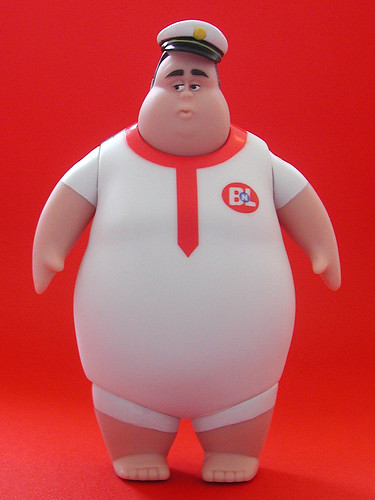
The film's storytelling carries over into the landscapes, primarily during the first half of the film. Mountains of garbage and a garbage-colored robot construct the film's bleak optimism. Humans have essentially turned the planet into a giant trashpile, under the watchful eye of a well-meaning yet ultimately destructive global corporation, who reassures the human race that everything will be taken care of planetside while they stay fat and happy on giant spacefaring luxury liners.
What's interesting is that the film never stoops to the level of a message film - the specifics of the story are necessary only to set up the characters and conflict, and the commentary on human nature is unambiguously positive. I found it fantastic that when we actually meet the humans, they aren't petty, selfish, apathetic, uncaring or anything else that you'd expect them to be in a film like this. Quite the contrary - lethargic and pampered as these doughy blobs may be, they're unfailingly kind and understanding, even resourceful and industrious when given the chance. Again - not the obvious, cynical path for the movie to tread, but something far more significant. (Predictably, self-conscious neocons have gotten their britches in a bundle about the perceived environmental messages in the story, proving that they're once again missing the point.)
Secondly, Pixar's gotten far better at integrating their gags with their stories. Pixar stopped including "bloopers" in their closing credits around the time that they began to take the films more seriously as stories rather than straight comedies. Charismatic and classic as Toy Story 2 or personal fave Monsters, Inc was, it's plain that Pixar has taken a different tonal approach with their movies beginning with Finding Nemo. Portraying your characters as actors in a movie just doesn't scan when your audience has to take the grief and love shown onscreen in any serious light. This isn't to say that they've lost the slapstick touch - the traditional short before the film is as clever and madcap as anything we've seen since the days of Looney Tunes - you can watch it here until YouTube takes it down).
WALL-E may be a kids' movie (certainly it appeals to kids), but it's as significant and genuine as anything you're likely to see in the top 10 this or any year. I highly recommend it.
On a related note, I like to think that I've shown remarkable self-restraint throughout this post by not referencing the imminent release of Hellboy II. Dagnabbit!
Saturday, June 21, 2008
A State of Fluxx

Lately we've been playing a neat little card game at my apartment called Fluxx, which we bought for our roommate's birthday after reading about it online. Fluxx is unique in that it begins with only one rule - "Draw one card, play one card" - and expands from there, often to gargantuan proportions. Interestingly, the way to actually beat the game can't be known initially; during the course of play various "Goal" cards will be played which will dictate the current terms of victory. Most of these goals involve possessing certain "Keeper" cards - temporary cards played in front of the player, a certain combination of which facilitate victory, provided that the proper "Goal" card is active. Some rules even allow two "Goal" cards to be active simultaneously. (In such a case, satisfying the requirements for either is enough for a victory.)
Things get particularly interesting when you add in the "New Rule" and "Action" cards. Rule cards remain active from the time they are played until they are removed or replaced by another rule card which makes the first obsolete. Most "New Rule"s involve thing such as hand limits, increasing the number of cards drawn or played per turn, or reversing play. "Action" cards are one-time only and very straightforward: "steal a keeper", "switch hands", etc.
At first I felt a sense of disappointment because Fluxx isn't nearly as amorphous as the web review made it sound - it's merely a straightforward card game with a certain number of varying parameters. Most of the "New Rule" cards don't change the game significantly, and building towards a victory is difficult because "Goal" and "Keeper" cards change often. Later I realized that the stable foundation is part of the fun. It can be hard enough to keep track of all of the rules that are sometimes in play (though some cards allow you to eliminate rules or even reset back to "Draw one, play one" rule with which the game begins). Some sense of stability helps to keep the game more fun and reduce confusion.

Fluxx already has a number of companion sets, which can be combined with other Fluxx decks or played separately. Earlier we played the compelling Zombie Fluxx, which my friend, an avid zombie buff, was practically forced to buy after his Fluxx deck arrived with an ad for the game. It turns out that it is possible to add additional chaos to the already-chaotic zombie formula. Zombie Fluxx is great fun, even if you don't combine it with an existing Fluxx deck. In fact, Zombie Fluxx plays slightly more traditionally, incorporating fewer parameter-modifying rule cards (like hand limits) and introducing a goodly number of zombie cards, which hurt rather than help you.
The deeper rules give the game versatility - certain "Keeper" cards double as weapons, and the four types of zombie cards behave in different ways. By killing active zombie cards or "scaring" them away, you can divert zombies to other players or remove them entirely. The entirety of the basic Fluxx formula remains, sans some of the more complicated cards the original offers.
Chances are you'll know from this review if this sort of game will appeal to you. We found Fluxx and its iterations in a specialty store for $12.95. You could probably find it elsewhere for cheaper.
Saturday, May 03, 2008
Cat Couldn't Scratch 'im
 (illustration by Tom Gauld)
We just got out of Iron Man, the latest Marvel-adapted Stan Lee superhero origin flick. My excitement level for this film has been exactly zero; as has been with so many superheros, I've never really been a fan of the metal man. Seeing the trailer last week piqued my interest, but the film itself has definitely won me over. Tony Stark (and Robert Downey Jr, for that matter) is a better Man of Steel than Superman has been for decades.
It's pretty dadgum good, if I say so myself, and I do. I don't know about you, but I like watching a superhero flick where the protagonist doesn't whine, and one where he worries about something other than his girlfriend. Naturally, some aspects of the film are unrealistic, but the movie's such a completely solid experience that you should just chalk it up to action movie license and enjoy yourself. The hero's internal dilemma is a great deal more topical and interesting than the tantrums and sputterings of heroes who have worn out their welcome.
Two hundred and forty some-odd posts ago, I let off steam in a rant about some of X-Men 3's and Spider-Man 3's particularly problematic points. I think that the success of Iron Man comes down to it being free of the problems I had with those movies:
Why? Why can't the third films be as subtle, charming and delicious as the others? Why must everything be caffeinated and fed through the filter of the Summer Blockbuster, even where the previous movies have avoided this tendency? Spider-man 3 alone jacked the evil twin concept, undermined the original film by changing story for the sake of concocting character motivation and introduced characters from the rafters to reveal important plot points to the audience when the movie couldn't figure out how to do it on its own. Every character and villain had so many bloody motivations that the movie became a swirling roller-coaster and lost track of its human elements. Three - count 'em, THREE - villains, and not one of them ever seemed to be acting like a human being.
Iron Man, on the other hand, feels natural and mature. It's also nicely directed, from the guy that did Zathura - another blah-sounding but pleasing picture. Iron Man is also the funniest superhero movie since Hellboy. Go see it.
Monday, April 28, 2008
Clumpy Reviews the Comedy So You Don't Have To (Oswalt, Proops and Wright)
 My patronship with the local library has given me access to wonderful new worlds of music. For some reason, for years I've only skimmed the "Rock" sections of the shelves. I decided to expand my horizons last visit (well, a couple of visits ago). In that vein, I'd like to get some library-fresh stand up comedy albums out of my system. I've been playing these sorts of albums lately at work, and they've had quite a medicinal effect on my sanity. After nearly a year of owning an iPod, I think that I'm starting to understand the versatility of the thing.
All of these three records are enjoyable in their own way, but I don't really think that I'll be spinning any of the three again (well, maybe Steven Wright). Some of this is sick, sick comedy. When a terrible, yet well-crafted joke or anecdote makes you laugh, that's great - heaven knows that some nice shock value can add to comedy. Check out Jim Norton for an example of how to pull this off (or, better yet, don't). Richard Pryor, like Mitch Hedberg, came across as intelligent and classy despite occasionally base material. I'm not endorsing blue material, per se, but I will say that a good guilty laugh can be therapeutic now and then.
Keep in mind that I'll be doing these comedy reviews sporadically for the next few weeks, among other reviews. These are comedy reviews, meaning that celebrity hacks (*cough* - Dane Cook) won't be given much space. See how the trio did below:
 Patton Oswalt
 Werewolves and Lollipops
Sub Pop (2007)
Like most comics who also happen to do voiceovers, Patton Oswalt bears little resemblance to his animated ally Remy, the rat from last year's Ratatouille. He's a jovial, acerbic, overweight man with a penchant for biting sarcasm and a tendency to incorporate little songs and sound effects into his commentary. He's also very funny, but not in a joke-telling, Emo Philips sort of way; he builds off of his audience more, most famously in the prolonged sequence where he berates a "whoo-hoo!" guy before continuing with his story.
The sarcasm may be too much for some to take, as it's sometimes tough to figure out whether he believes what he's saying. Sometimes it feels as if he goes too far intentionally just to mock his own position; for example, a fairly hilarious bit satirizing television censorship begins with a shocking, non sequitur blur of profanity. If you plan on purchasing or listening to this album, I suggest you view some of his clips on YouTube or on Late Night talk shows - he's always in character.
Humor: 7.5
Personality: 9
Grossitude: 7
Link
 Greg Proops
 Houston, We Have a Problem
Stand Up Records (2004)
Greg Proops is a gem of sorts, and probably one of the most audacious comics working today. Much like with Bob Saget, his television persona is far gentler and safer than the guy you see in the club. And exactly like Bob Saget, Proops gets most of his fun from mocking the audience, provided that they're in on the joke. Houston, Texas (hence the title) provides ample mining ground for stereotype exploitation and controversial statements. Proops' verbose commentary is never quite as flowery as when a joke bombs and he sets his sides on the crowd. I noted that the crowd seems to get quieter and quieter throughout this record, but it's not really a consequence of weak material; every word counts in Greg's delivery, and throwing out a guffaw might miss you a punchline.
Proops goes all-out for the final few minutes, in a prolonged gag questioning Jessica Simpson's mental acuity. Though he picks a predictable target, the magic is in the delivery:
"It's difficult to ascertain how much information Jessica is deriving at any given moment. Because her face, in repose, is a pizza of discomfiture and query. I mean, where you would see a person or a car, she just sees swirling oblongs and fractals. Everything looks like the Matrix; just green numerals running up and down a wall, unfathomable, eternal."
Humor: 8.0
Personality: 8
Grossitude: 6
Link
 Steven Wright
I Still Have a Pony
Comedy Central Records (2007)
(Note: I am required by law to use the following words in this review: deadpan, surreal.)
I review this album with an air of reverence. For the long-time comedy crowd, anticipation for this album rivaled the hooplah surrounding the release of all of the records that Brian Wilson's been sitting on. A subtler comrade to his brother comedians from the 80s (like Emo Philips - there's that name again), Wright finds himself in the company of the select few who fall so completely into their routine that they become original characters even as they mumble non sequiturs and surreal one-liners. ("I have a new camera. It's so advanced, you don't even need it.")
Wright's been at the top of his game for as long as I've been alive, and I must in all honesty admit that this album is the best of the three I've reviewed today. The jokes are top-notch and the delivery is deadpan but not without expression. Unfortunately for me, something about Wright's voice begins grating into my eardrums after a short period, slowly grinding out my nerves and auditory machinery until I'm forced to take a break. It's completely my problem, and I'm sure that most of the rest of you won't have this issue. In any case, it forces me to limit to about half of the album at a time. This is, of course, just fine; the other half isn't going anywhere.
Humor: 9.0
Personality: 7
Grossitude: 3
Link
Note: I haven't just been playing comedy at work - I've also gotten into some great world music lately from Kenya, Mali and even ethnic music from Japan. Stay tuned for similar mini-reviews later this week. Fun stuff.
Subscribe to:
Posts (Atom)